
The Bachelorette and Our Complicated Relationship with the Truth
by Keegan Drummond
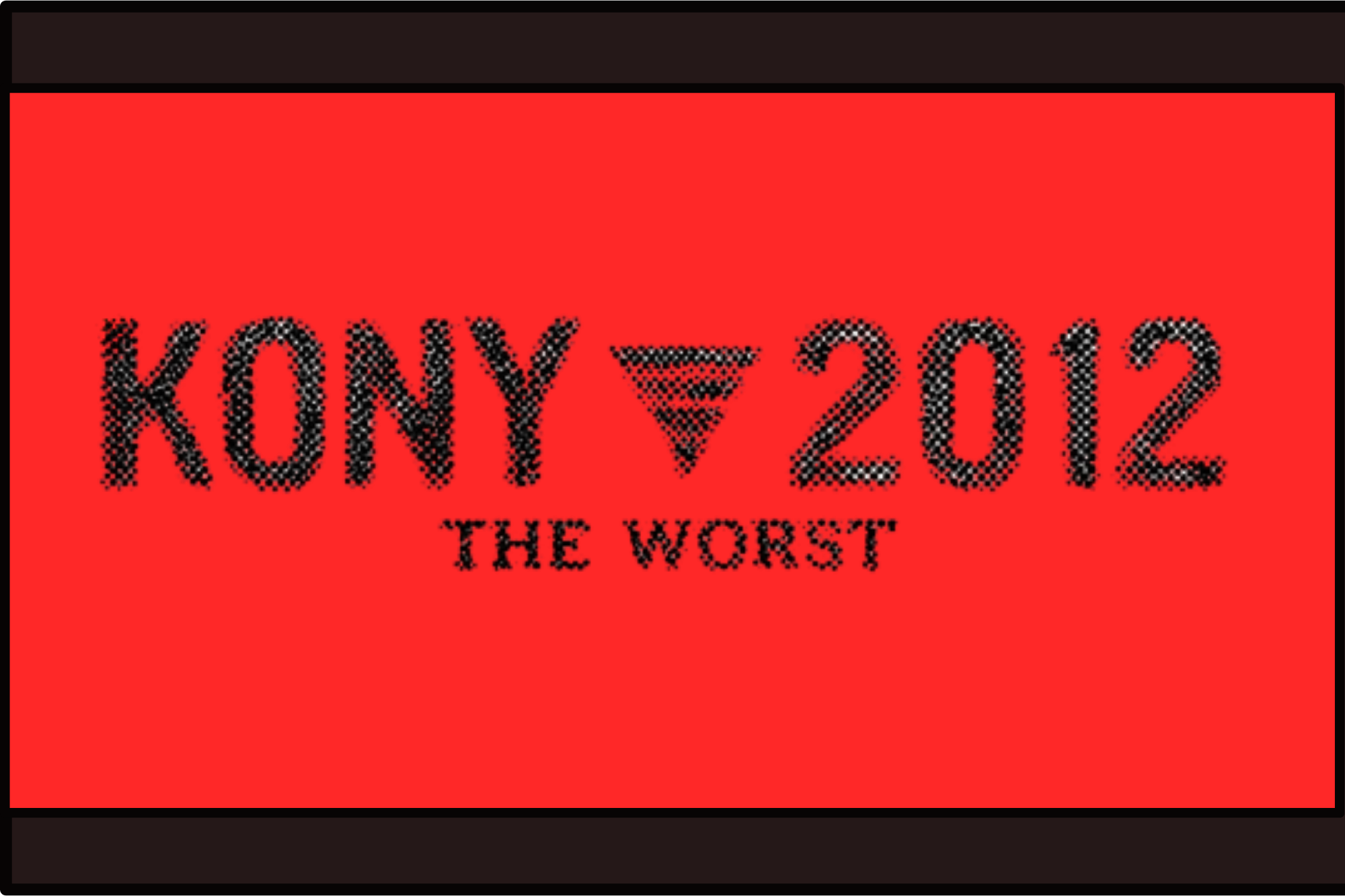
Kony 2012 Sticker (2026) Image recreated by Mia Burke courtesy of Canva.
“Reality TV resembles our society’s complicated relationship with the truth in that the “full truth” is often too much to take, and half-truths are more easily stomached.”
When I was 15, I saw a T-shirt with a picture of an African child soldier through the front window of a streetwear shop that used to be in Pearlridge Mall. I feel like Kony 2012 was a watershed moment for the onset of millennial outrage. I wonder where all of the Invisible Children merch went… On the T-shirt, the child was holding a machine gun with some text above that read “The Real(er) World,” of course, a dig toward the long-running MTV reality show The Real World. As a high school sophomore, that seemed like some compelling stuff. I had never watched The Real World, but if it were like any other MTV reality show I had watched (Next, Parental Control, Jersey Shore), it was fake and trashy, and it should not preoccupy the mind like the real and horrifying atrocities taking place around the world. But wait. Wasn’t Kony 2012 somewhat misleading and problematic for highlighting a guy that wasn’t even in Uganda anymore, exaggerating the scope and reach of a dwindling LRA, and perpetuating a white-savior complex that patronizes a failed Africa for most of the West? Probably. So, is reality TV that bad after all? Maybe the manufactured plotlines of trashy reality TV fit perfectly into a culture that willingly throws itself into our obfuscated (mis)understanding of the truth. In fact, reality TV is a microcosm, albeit an extremely problematic one, of how the modern mind relates to truth in a world where the truth feels like too much to bear.
We all know that reality TV is a manufactured slice of real “reality” – just ask the producers of the new season of The Bachelorette. To any real Bachelor Nation fan, we were all fairly disappointed about ABC’s departure from the traditional casting of a Bachelor alum as the new Bachelorette, opting to instead cast Taylor Frankie Paul of Secret Lives of Mormon Wives fame as the new Bachelorette. ABC told us we were getting something new in a Bachelorette: a divorcee, a mom, and a rabid fan base obsessed with a messy “soft swinging” storyline that carried the original “Mormon Wives” to stardom. While fans and ABC, for that matter, were aware of Paul’s 2023 domestic violence arrest, the world found out in late March the extent of that incident in late March of this year when TMZ aired a leaked video of Paul attempting to strike her then-boyfriend with her 5-year old daughter in the room and then allegedly throwing metal stools and wooden playset at him.
Person Holding Black Remote Control (2020) Photo by Erik McLean courtesy of Unsplash.
ABC pulled the plug on Paul’s season of The Bachelorette just three days before it was scheduled to premiere. Some Bachelor alumni are convinced that Disney (ABC’s parent company that is currently worth $171B) must have been aware of this video, as ABC has always thoroughly vetted its casts. If that is the case, what slice of reality was ABC so keen on presenting in Paul, and how did it conveniently leave out such a problematic liability in this tragic incident? This tendency towards masking the truth at one of the largest TV networks is the same tendency prevalent in reality TV sic passim, and the tendency in all of us.
Regardless, reality TV necessarily involves some editing of – reality, as not everything can possibly be included (as scandalizing as they may or may not be). They are half-truths. Still, as Benjamin Franklin said, isn't “half a truth often a great lie?”[1] In some ways, these aren’t too dissimilar to the half-truths we are exposed to every day. I wonder why we tolerate them. Can we handle the “full truth?”
Reality TV resembles our society’s complicated relationship with the truth in that the “full truth” is often too much to take, and half-truths are more easily stomached. My wife and I are prime examples of this. My wife is one of the smartest people I know. She is a PhD student in Social Psychology at an R1 institution. She is a recipient of the prestigious Graduate Research Fellowship Program grant from the National Science Foundation. She is published in multiple scientific journals and is currently working on an interdisciplinary, interuniversity, multi-year study. She only watches reality TV. After a long day of work, she and I both sit down and (depending on the time of year) watch Survivor,The Amazing Race, The Challenge, The Bachelor, The Traitors, and more. Our careers are exhausting. I’m sure whatever is going on in the world is terrible, and my apathy is probably very disappointing to some readers. I simply do not have enough energy to care.
“Reality TV feels off because it portrays the transcendentals through an imperfect lens. The beauty portrayed is purely at the base level of appetite. The goods pursued are the lesser and immediate goods. The truth is edited, partial, and often distorted. ”
Fiction is just as bad in that it attempts to reveal some semblance of the truth, but it does so through artificial or grandiose ways. There’s too much subtext. Everything is a commentary. They are trying to capture something real, but there is some disconnect between your favorite writer’s Moleskine and a sweaty producer breathing down a director’s neck, trying to conjure up award bait. C.S. Lewis once said that literature and art that tries to be original will always fail to be so, but, “if you simply try to tell the truth … you will, nine times out of ten, become original without ever having noticed it.”[2] Modern fiction’s attempt at conveying an original idea will always feel contrived. Reality TV will remain original by simply having hot mics and hidden cameras scattered throughout a mansion in Santa Monica, and letting people “tell their truth.”
So, for reality fans like us, we will settle for the half-truth. We are completely satisfied with bingeing the new season of Love is Blind. We are not trying to tune in to the six o’clock news to hear about the most recent global moral crime that I am supposed to be upset about, or go on Disney+ to watch some spandex-clad supermodel save the multiverse. But again, aren’t these storylines just convenient angles like Kony 2012, designed to get us to channel our outrage into what wars to back, what rallies to attend, and what trendy merch to buy? I’m content living outside of the “real” storylines – give me “reality” in all of its half-truths.
Perhaps I’m fine with the half-truths because I do it so much. I tell half-truths – lies if we are all being honest– about everything. I lie about mostly pointless stuff that doesn’t even matter: where I am from, how long my commute used to be, how many hours of sleep I got last night, why I didn’t text back. It feels instinctive. Most of the time, I don’t even realize I am doing it. Lying is just part of my own projected reality. It’s probably not what you wanted to hear from someone with an M.Div, but I’ve lived through enough church scandals to know that my lies are fairly innocuous compared to most ex-seminarians. Yet, the truth seems unattainable at times –especially considering our tendency to obscure it.

A Sign that Says Bach and Boulee (2023) Photo by Blair Roberts Castagnetta courtesy of Unsplash.
Still, as I reflect on my willingness to give my attention over to the curated “reality” of reality TV and my tendency toward deception, I cannot help but think about the transcendental of truth. In theology, we often speak of transcendentals of truth, goodness, and beauty as they relate to God. Man seeks out these transcendentals by means of the faculties of the soul. We pursue truth through our intellect, good through our will, and beauty through both intellect and appetite (as it is apprehended and enjoyed). These three are, of course, bound together by the transcendental unity. These transcendentals are present throughout all of creation – that which is istrue, good, and beautiful. Of course, when speaking about God, we cannot speak of these transcendentals in the same way we do of creation, since God is the cause of transcendentals. This is a necessary distinction as God cannot be compared to the effects (namely creation) He causes. Nevertheless, these transcendentals must be found in a higher way in Him. God is Truth, Goodness, and Beauty. So, in light of the theological tradition’s exploration of the Truth, it feels ridiculous to discuss the truth of reality TV – but we shall try anyway!
Reality TV feels off because it portrays the transcendentals through an imperfect lens. The beauty portrayed is purely at the base level of appetite. The goods pursued are the lesser and immediate goods. The truth is edited, partial, and often distorted. Certainly, in reality shows like The Bachelorette, some real goods are portrayed and rewarded (love, friendship, sacrifice, perseverance), which is why it can be so engaging. Even so, it mostly entices the lower faculties of the soul (emotions, passions, senses, imagination) while touching on the higher faculties (intellect and will), but in a contorted manner.
In a similar way, many of us struggle to move beyond these base faculties in reality reality. We stimulate the appetite, our wills are oriented toward the lower goods before the higher goods, and our intellects are selective in their attention toward the truth. This is prevalent in the relationships we maintain, the conversations we have, and of course, the shows we watch. Even problematic campaigns with great intentions (i.e., Kony 2012) seem susceptible to this distortion of the faculties.
If we are to ascribe an etiology for our misguided relationship with the truth, it would be that we are not allowing our faculties to be formed. Reality TV, Instagram feeds, Kalshi bets, and all the other modern vices are ways in which we anesthetize the faculties; we subdue them because the real work of formation is much too difficult, because they are boring, and habitual. Prayer, temperance, liturgy, and the exercising of other virtues require time and attention in things that do not immediately arouse the sensitive appetite. Yet, it is clear that if we wish to abandon half-truths for the full-truth, we must submit these appetites in addition to our intellect and our will to that which is True, Good, and Beautiful.
WORKS CITED
Franklin, Benjamin (Under Richard Saunders), Poor Richard’s Almanack (Philadelphia: Benjamin Franklin 1758).
Lewis, C.S., Mere Christianity (New York: Harper One 2002) Pg. 106.
Resources
We’ve created a free downloadable PDF to explore the article deeper. It contains discussion questions about the topic in general terms that will give you a jumping-off point for beginning a conversation.
The second page contains a way to see the topic from a biblical perspective.
And finally, to go deeper into the subject, we have chosen a few curated resources to explore from other authors’ and thinkers’ research or perspectives.
Read. Engage. Enjoy!
WHAT DO YOU THINK?
Depending on how a gem is held, light refracts differently. At B+PC we engage in Pop Culture topics to see ideas from a new angle, to bring us to a deeper understanding. And like Pastor Shane Willard notes, we want “…Jesus to get bigger, the cross to get clearer, the Resurrection to be central…” Instead of approaching a topic from “I don’t want to be wrong,“ we strive for the alternative “I want to expand my perspective.”
So, we invite you to engage with us here. What piqued your curiosity to dig deeper? What line inspired you to action? What idea made you ask, “Hmmm?” Let’s join with our community to wrestle with our thoughts in love in the Comment Section! See you there!
