
No Fear In Love: Healing Trauma in All Creatures Great and Small
by Bonnie Schultz

Two Brown Cattle on Grass Field (2019). Photo by Ricardo Gomez Angel courtesy of Unsplash.
It started with Mia asking me to be on a podcast again. This invitation prompted a feeling of dread, but I'm learning to pay closer attention to my emotional responses. I’m learning to ask Jesus about what I’m feeling when I notice it. Trying to get to the bottom of this feeling of dread, I did what I do more and more often these days: I asked Jesus a question, then listened. “Will you bring to mind a time when I felt that way before?”
A memory of when I tried to speak in front of my elementary school classmates and stuttered came to mind. I saw the discomfort in my classmates’ eyes. Maybe they were afraid they too would stutter on their turn to speak. Then God brought to mind an episode of All Creatures Great and Small I had recently watched, where a character was invited to face his own fear, but he failed miserably at first. Freezing, then running away. But I am getting ahead of the story.
All Creatures Great and Small (2020-2026) is a PBS series based on the veterinarian experiences of James Alfred Wight in the 1930s and 1950s. The series takes place in the fictional small town of Darrowby, England. Siegfried (Samuel West), the older Farnon brother, is an experienced veterinarian who raised his younger brother, Tristan (Callum Woodhouse), after their parents’ deaths. Throughout the show, Tristan also trains as a vet and joins the practice.
At the end of Season 3, Tristan leaves to serve in the Royal Army Veterinary Corps.
In the current season, Season 6, Episode 6, entitled “Our Hearts are Full,” it is 1945, and Tristan is home on leave from the war. War always makes a personal impact, and we are about to discover its effect on Tristan and the role a horse plays in his recovery.
Elijah Wentworth, a client, calls the veterinary office asking for help with his ailing Shire horse, Weissmuller. Not Siegfried’s favorite client, he is eager for Tristan to come with him on this particular call. Plus, Tristan has a reputation for being very good with horses. Tristan agrees, and off they drive to the farm.
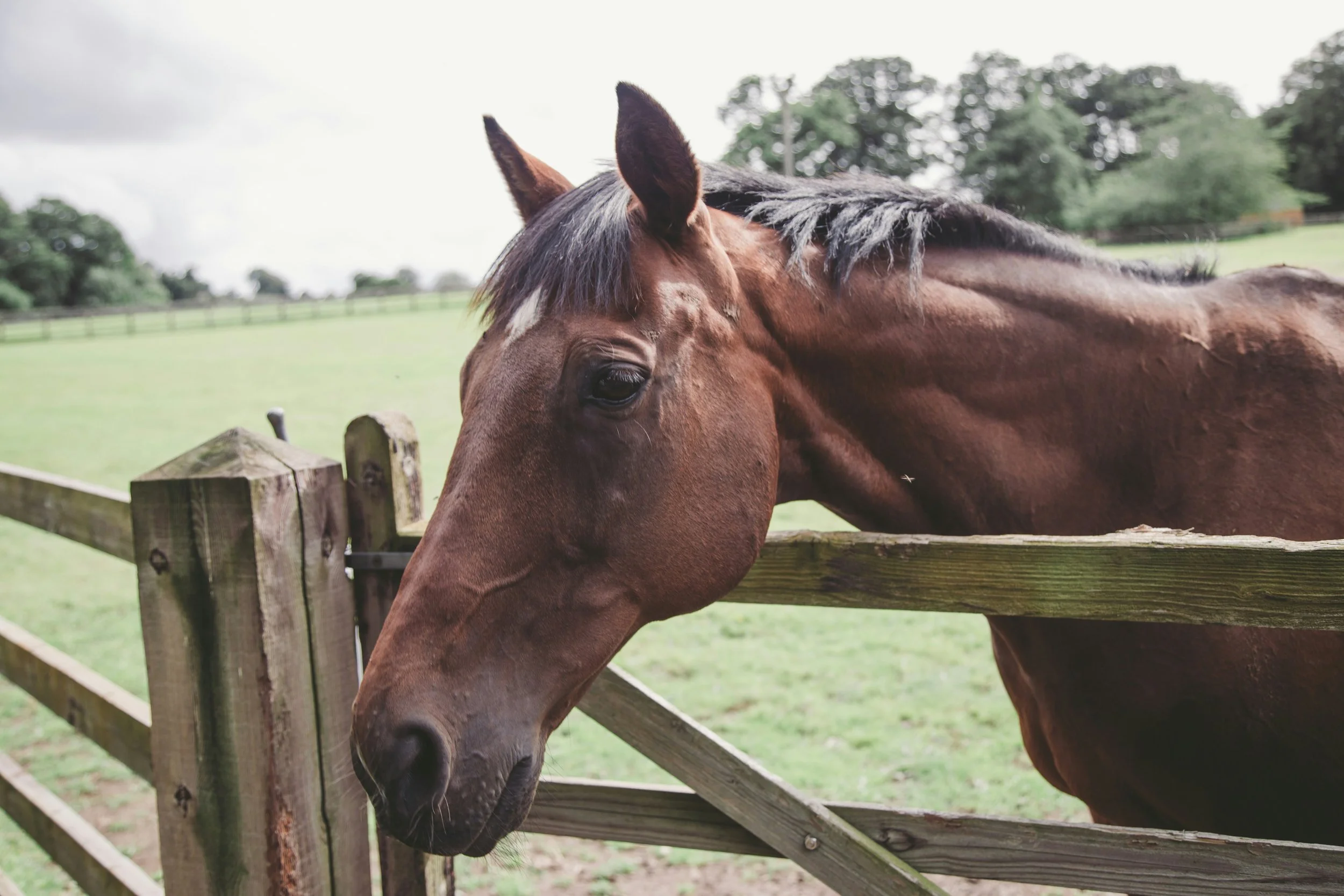
Horse Vet (2023). Photo by Ambitious Studio* | Rick Barrett courtesy of Unsplash.
“Healing occurs when what is shared is heard with empathy and understanding. And recovery finally takes place when emotions are released.”
Siegfried takes one look at the imposing Weissmuller and notices the unusual angle of one hoof. Placing a hand on the hoof, he discovers it feels warm. Herein lies the problem. One touch reveals an abscess. It’s clear what to do. Open it up. Get to the infection. Drain it away.
But Weissmuller is spooked. Calming the horse is imperative. Siegfried directs Tristan to stand by the horse’s head to calm him. Tristan starts in the horse’s direction, but as he looks more closely at the horse, something stops him. He pauses. He freezes, really.
What is wrong with Tristan?
Siegfried has a harder time diagnosing his brother’s condition than he does the horse’s. Even he will admit that Tristan has always been really good with horses. All he is asking him to do now is stand by the horse's head, after all. But Tristan doesn't move. He doesn’t appear to even hear. In the end, he just runs away, literally. He takes the car, leaving Seigfried stranded.
Back at home, it’s dinnertime. The family gathers around the table, but Tristan doesn’t eat much. Before the meal is done, he excuses himself to go to his room. Later that night, most of the family is already in their beds. Only Siegfried lingers, listening to the radio. Just before midnight, Siegfried hears the alert. A news announcement is expected in just a few minutes.
Sensing an important announcement about the war, Siegfried rushes from room to room, waking each family member. Calling them to come quickly to listen. They gather around the radio. And there it is. WORLD WAR II IS OVER! Everyone laughs, shouting with joy, dancing, and hugging each other. All but Tristan. Without so much as a smile, he quietly retreats to his room. Which is completely out of character for the normally jovial jokester, younger vet.
In the morning, Tristian doesn’t join them for breakfast. Finally, the two older vets and the housekeeper check. He is not in his room. Where would he have gone?
Out in the community, they look. A neighbor has seen him at the church. At the church?! Siegfried goes to find him. There he is, sitting alone on a church bench. Like the good doctor he is, Siegfried begins the gentle probing.
“Leave me alone.”
As the brothers sit side by side on the church bench, in an effort to draw Tristan out, Siegfried begins to speak of shared memories, of happier times.
“Why don’t you go away?”
Then he asks about the military cross Tristan was awarded in the war. The one that had been found in his room, which Tristan had never mentioned.
Ah, a good question.
Tristan slowly begins to tell the story.
During the war, in the midst of an attack, his comrade alerted him to a nearby land mine. “Don’t move!” Tristan’s life was saved because his friend acted. But he wasn’t able to save his friend, who was later killed in that skirmish. Yet Tristan is alive. And to make matters worse, he was awarded the military cross. The injustice of it all!
Now Siegfried gets it. Now he understands that Tristan’s reaction to the horse was not really about the horse. He says, “You weren’t afraid of the horse. What you couldn’t bear was his fear.” Meaning, not the horse. But his friend’s, his own. Tristan sobs, letting it all out in his brother’s arms.

Two Hands (2018). Photo by Toa Heftiba courtesy of Unsplash.
I love this episode for how it helps us see the way unresolved trauma plays out in ordinary life. We can see the symptoms of trauma in the horse: His skittishness, the fear in his eyes, the pain. He’s ready to run if he could, but he is tied to the fence and tethered, looking ready to fight anyone who comes near.
We see the signs in Tristan, too. These are what mental health professionals call derealization, the feeling of being disconnected from the world around us. Tristan is no longer hearing Siegfried’s voice, let alone processing or following directions.
The reactions we see in Tristan are greater than the current situation warrants, indicating “triggering.” That is, events happening in real time are bringing up a traumatic event from the past.
He exhibits the “freeze response.” Tristan is immobilized. He doesn’t or can’t move toward the horse. He doesn’t move at all. Then, when he “unfreezes,” he “flees.” Literally. He runs away, gets in the car, and leaves his brother stranded.
Tristan’s responses are not quickly resolved. Later that evening and into the next day, he continues to show the signs of trauma: He experiences loss of appetite. At dinnertime that evening, with the family around the table, food doesn’t appeal to Tristan at all. He leaves the table without eating.
He experiences depression, a low joy mood, leading to a lack of interest and motivation. Tristan doesn't celebrate even at the very joyful news that the war is over!
It’s helpful to be aware of these responses in ourselves and others. Seeing them in stories like this one raises our awareness of them. But what good is that if we don’t know what to do about it?
In this episode, the story explores some ways recovery and healing take place. We see it in the context of a loving relationship. Siegfried and Tristan know each other well, and underneath the daily irritations of living together, they really do care for each other’s well-being. When Tristan is finally able to tell the story of the original war wound. Hearing himself say it out loud is part of the healing. Healing occurs when what is shared is heard with empathy and understanding. And recovery finally takes place when emotions are released. Somehow, they are contained better when shared.
We take for granted that God designed our bodies to heal. First, the wound bleeds, then the body stops the bleeding (homeostasis). White blood cells move in to clean the wound (inflammation). The body makes new skin tissue and repairs broken blood vessels (proliferation). Finally, the wound closes. (remodeling)
In the same way, God has healed our souls.
He heals the broken-hearted and binds up their wounds (healing the pain and comforting their sorrow).
-Psalm 147:3 (Amplified)
God also uses His people to be participants in His healing process. First, we receive God’s love, then we can offer it to others.
Dear friends, let us continue to love one another, for love comes from God. Anyone who loves is a child of God and knows God.”
-I John 4:7 (NLT)
Such love has no fear, because perfect love expels all fear.”
-I John 4:18a (NLT)
Tristan can’t calm the horse until he himself is no longer full of fear. Receiving empathy from his brother relieves his fear.
Helpers have to see beyond the symptoms of the trauma, caring more about the person than the problem they present. Who can love someone who is acting unreasonably?
Symptoms of trauma can be offensive. We don’t like it when someone lashes out in anger toward us, ghosts us, won’t listen to us, or resists our efforts to get close to them.
As God’s people, we can see these occurrences as an opportunity to "enemy love.”
To you who are ready for the truth, I say this: Love your enemies. Let them bring out the best in you, not the worst. When someone gives you a hard time, respond with the supple moves of prayer for that person.
-Luke 6:27 (MSG)
The reality is, God is love.
In this is real love - not that we loved God, but that He loved us and sent His Son as a sacrifice to take away our sins.
- I John 4:10 (NLT)
Apparently, I was still spooked by the idea of having to speak on a podcast. Reflecting on this episode has been part of the process of relieving my fear. Like Tristan seeing fear in the horse’s eyes, the memory of seeing fear in his comrade's eyes came forward. Reading about his experience brought forward my memory of seeing the discomfort in my classmate’s eyes.
When a forgotten memory is uncovered, it can be healed; drained of its infection, helped to heal by those who come to our aid, and recovery is possible. In the end, Tristan is able to go back to carry out his task with the horse. In the end, I am able to carry out mine. The podcast has been recorded. I am just a little freer having done it.
WORKS CITED
“Our Hearts are Full,” All Creatures Great and Small, S 6, E 6. Hay, Andy, aired February 15, 2026, on PBS.
Resources
We’ve created a free downloadable PDF to explore the article deeper. It contains discussion questions about the topic in general terms that will give you a jumping-off point for beginning a conversation.
The second page contains a way to see the topic from a biblical perspective.
And finally, to go deeper into the subject, we have chosen a few curated resources to explore from other authors’ and thinkers’ research or perspectives.
Read. Engage. Enjoy!
WHAT DO YOU THINK?
Depending on how a gem is held, light refracts differently. At B+PC we engage in Pop Culture topics to see ideas from a new angle, to bring us to a deeper understanding. And like Pastor Shane Willard notes, we want “…Jesus to get bigger, the cross to get clearer, the Resurrection to be central…” Instead of approaching a topic from “I don’t want to be wrong,“ we strive for the alternative “I want to expand my perspective.”
So, we invite you to engage with us here. What piqued your curiosity to dig deeper? What line inspired you to action? What idea made you ask, “Hmmm?” Let’s join with our community to wrestle with our thoughts in love in the Comment Section! See you there!
